Quick Links
Resources | Audio file downloads | Homework syllabus | Index
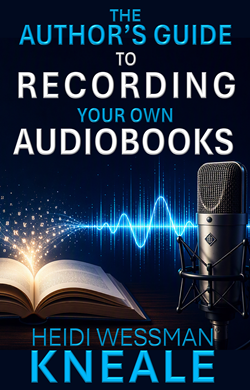
This is the companion page to my non-fiction guide “The Author’s Guide to Recording Your Own Audiobooks”. Find here all the links, videos, resources, sample sound files and more to accompany your journey through creating your own audiobook.
I’m an Australian author who, thanks to a sound engineering background, records her own audiobooks. And you can too! “The Author’s Guide to Recording Your Own Audiobooks” is an in-depth guide sharing my process of creating audiobooks in my own home, on my own laptop, and shows you how you can do the same.
This Australian-friendly book covers:
- The hardware and software you need to get productive, including microphones, recording space, and the Audacity software (plus useful plug-ins)
- Useful info on narration skills, including speaking speeds, acting skills, tips and more, to lift the quality of your narrating voice
- Sound wave theory and other in-depth info for a better understanding of how to engineer sound
- Step-by-step guides to recording, editing and mastering sound files, including Quality Assurance (QA) tips, so you can turn out pro-level audiobooks.
- Useful exercises (“homework”) to give you a chance to practice your skills before you attempt a big project
- Pointers for music sourcing, audiobook cover guidelines, packaging, distribution and resources to get your book out into the world
- Legal information and other CYA things of which to be aware
Where you can get a copy from your favourite retailer:







Resources
Here I list all the resources I mention in this book so you don’t have to go back and hunt them down. Note: this is not an exhaustive list of all possible resources found online that help an author become a better audiobook narrator. I encourage you to hit up your favourite search engine and explore further.
Websites
Informative websites referenced within the book.
- Where to download the software editing application Audacity Audacity is beloved by many audiobook producers for its price point (free!), its easy-to-use features and it’s many Nyquist plug-ins that make mastering an audiobook so simple.
- Audacity’s Audiobook Forum with many useful people and info.
- The KoboBooks page for my audiobook “Her Endearing Young Charms” where you can listen to a sample of one of my books in the wild.
- Australian Actor/Narrator Payscale information, in case you decide you don’t want to narrate, and want to know how much you would have to pay a narrator.
- Nathan Lowell’s “Golden Age of the Solar Clipper” series (science fiction), an audiobook narrated by the author, to see another example in the wild.
Glossary of Further Information
For those of you who’d like to go more hard-core into theory.
- Hertz: note frequencies and pitches
- Shaka sign from Hawaii (or how far away from your mic you should be)
- Singing pitches (human range)
- Decibels, the amplitude and loudness of sound
- Stereo sound
- Mono sound
- MP3 format for sound files (compact)
- WAV format for sound files (lossless)
- Royalty-free guidelines for sound use
- Public Domain
- Public Domain info for music
- Free Music
Narrator help online
Other narrators who want to see you succeed.
- Patrick Fraley, who offers free narration lessons
- Narrators Roadmap, an excellent all-round resource
- Tanya Eby asking if you want to be a narrator
- Sean Pratt’s test to see if you suit narration (on YouTube)
Quality Submission Specs
These are the specifications that each aggregator requires for audiobook files distributed through them. ACX tends to be the gold standard, but the others might have slightly different guidelines (e.g.: the naming of sound files, etc)
Music source sites
If you aren’t composing your own music, here’s some sources for intro/outro/entrace music to include in your audiobook, if you want.
- Envato Royalty-Free music, including their license terms
- UK’s Media Music Now, including their license terms
- Getty Images (TripleScoop Music)
- Musopen, free music without copyright restrictions
Audiobook Aggregators and Distributors
Once you’ve created your audiobook, here’s how you can get it out in the world.
- Audible/ACX (Audiobook Creation eXchange) note: ACX requires you to have a US, UK or Canadian bank account before they will let you distribute through them. This requirement is a barrier for many Australians to distribute directly through them.
- Voices by INaudio (formerly Findaway Voices) (will distribute to Audible and other sites)
- Author’s Republic (will distribute to Audible and other sites)
- Kobo Writing Life (distributes directly to Kobo Books)
- Google Play Books (distributes directly to Google Play Books)
Author organisations that offer contract review services
YouTube Videos
- mine: How I Record an Audiobook: From Go to Woah!
- mine: Audiobook Narration Voice Techniques for Authors
- Tuning the Orchestra
- Adam Neely explaining how slow is too slow
- Sean Pratt’s test to see if you suit narration
- INaudio has a YouTube video for mastering in Adobe Audition
- Stephen Fry on issues while narrating Harry Potter
Nyquist plug-in downloads for Audacity
Download and install these Nyquist plug-ins to enhance the functionality of Audacity.
Audio file downloads
These files are provided under a Creative Commons 4.0 License for the purpose of supporting the exercises and examples in this book. Due to the nature of some of these files, they are covered by one of two different license types:

CC BY-NC-ND (Attribution-NonCommercial-NoDerivatives). You may download these files for personal use. You must attribute them if you share them. You may not alter them, remix them, or create derivative works. Use of these files are only for non-commercial purposes.

CC BY-NC (Attribution-NonCommercial) You may download these files for personal use. You may alter them, remix them and create derivative works. You must attribute them if you share them. Use of these files are only for non-commercial purposes.
ch 1.3, p40
Words Per Minute – for listening to:
ch 2.4, p64
Pride and Prejudice Raw Reading
download: Pride and Prejudice Raw Reading.WAV for playing with
Or an MP3 if you just want to listen to it:
Ch 2.4, p69
Pride and Prejudice Editing Reading – for listening to:
Ch2.4, p71
WHC Ambience 2 for listening to (best listened with headphones for full stereo effect)
Ch 3.3, p87
Too Slow Speech
Ch3.3, p87
Excerpts from The Rainbow Passage [reference: Fairbanks, G. (1960). Voice and Articulation Drillbook, 2nd ed. New York: Harper & Row. pp124-139]
The Rainbow Passage at 140 wpm:
The Rainbow Passage at 160 wpm:
ch 4.1, p112
Download: Master_Sample_raw_track.wav for playing with
Ch 4.1, p114
Master Sample mastered track, after applying mastering (compare with previous)
ch4.3, p122
Chapter header sample from “Her Endearing Young Charms”
ch4.3, p123
Opening sequence: 000_Her_Endearing_Young_Charms.mp3
ch4.3, p124
end credits: 019_Her_Endearing_Young_Charms_End_Credits.mp3
ch4.3, p135
Theme music for “Her Endearing Young Charms”
ch4.3, p135
Theme music for “For Richer, For Poorer”
ch4.3, p136
Incidental music: Merrybelle’s Lament
Homework
A list and short summary of all homework assignments, designed to introduce you to the process of creating an audiobook. Lessons start with:
- observation of the ambient sound environment around you
- listening, observation and analysis skills
- learning how to use your equipment through recording
- narration experience, including analysis and critique
- gauging your speaking speed
- editing a short passage
- mastering a short passage
- combining all skills into a short project
For detailed information, please refer to the page listed in this book.
| Page | Homework assignment summary |
| p26 | Listen to the ambient sound in your environment. Are you aware of the sounds about you? Identify your current environment’s “room tone”. |
| p26 | Get a recording device and record thirty seconds of ambient sound. Compare to your live experience. |
| p32 | Record a minute or two of ambient sound (room tone), then do a voice check, recording several paragraphs of text. Listen to the recording, trying to identify any unwanted noise, including echoes, etc. |
| p33 | Record you reading a few minutes of text and save it for later analysis. Then read section 2.1 |
| p38 | Go through the list of techniques in 2.1 and compare your previous recording. Listen to the recording with a critical ear and analyse it. Make notes of what you did right and what you would like to change. |
| p38 | Make a timed five-minute recording of you reading a scene from your book. Do a word count from your book, then divide this by five to get your preliminary speaking speed. Also, listen with a critical ear. Did this performance improve compared to the previous one? Feel free to repeat this homework assignment. Practice will improve your narrating skills. |
| p69 | Take a sound file you recorded. Listen through it and identify your unwanted noises: noisy breaths, coughs, sniffs, etc. Become aware of the unwanted noises. |
| p79 | Grab your first recording of your voice (see p32). Analyse your voice. What is good about it? What would you improve? |
| p85 | Read aloud this 100-word section from The Rainbow Passage and time yourself with a stopwatch. Use the table on p86 to determine your speaking speed. Do you need to speed up or slow down? |
| p96 | Select a few different passages from your book, choosing different moods or vibes. Record yourself. Listen with a critiquing ear, analysing your performance. |
| p99 | Grab an earlier recording of yours (p96) or lay down a fresh recording of a few paragraphs. Give it an editing pass (chapter 2.3) to clean it up. We’ll be mastering it later (p113). |
| p112 | Download this sample raw track and master it. |
| p113 | Take that edited recording from p99 and apply the mastering steps. Can you sample pass ACX Check? |
| p129 | Record a thirty-minute passage of text. Check it against the checklist. |
| p170 | Take this thirty-minute passage of text that you recorded. Edit it, master it, and share it with the world. |
Index
…of all the good stuff in this book.
- accent, See voice:accent
- actor
- cost of
- Actors Equity
- ACX
- quality assurance
- ACX Check
- quality assurance requirements
- additional resources
- Adobe Audition
- AI (artificial intelligence)
- Generative AI (GenAI)
- Language Learning Models (LLMs)
- Alliance of Independent Authors (ALLi), The
- amplitude
- failing Quality Assurance check
- articulation
- Audacity
- Audiobook Forum
- editing
- effects
- playback
- recording with
- tools
- Audacity effects
- Equalization
- Limiter
- Loudness Normalization
- Low Rolloff for Speech
- Noise Reduction
- audiobook covers
- Audiobook Creation ExchangeSee ACX
- Australian Society of Authors, The
- Author’s Republic
- backmatter
- bitrate
- book script
- breathing
- closing credits
- clothing
- computer
- contract – See legal information, contract
- Creative Commons license
- dB – See decibels
- decibels
- disclosure list for a narrator
- distribution
- e-commerce site
- packaging
- earphones
- editing
- effects – See Audacity, effects
- ElevenLabs
- Envato
- file
- backup
- download
- export
- format
- format conventions
- length
- mastering
- naming conventions
- saving
- size
- Findaway Voices
- format
- .MP3
- .wav
- .zip
- mono
- frequency
- GettyImages
- Google Play Books
- hardware
- Hertz
- high-pass filter
- homework
- list of
- Hz – See Hertz
- INaudio
- quality assurance requirements
- inflection
- ISBNs, Thorpe-Bowker
- issues
- amplitude
- computer
- hardware
- microphone
- noise
- sound
- Kobo Writing Life
- laptop
- legal information
- art rights
- audiobook rights
- contract
- intellectual property
- IP rights
- licensing agreements
- music rights
- owning music copyright
- royalty-free music
- sound effects rights
- Terms & Conditions
- levels
- microphone
- speaker
- library, public
- limiter
- mastering – See file:mastering
- order of operations
- MediaMusicNow
- metadata
- conventions
- template creation
- microphone
- alternatives
- condenser
- dynamic
- ribbon
- USB
- Zoom
- mono
- music
- Creative Commons
- crediting
- custom composed
- Public Domain
- royalty-free
- sourcing
- Musopen
- naming conventions
- narration
- “dry” (without music)
- accent
- performance
- quality
- relaxed
- skills
- slow down
- techniques
- tips
- narrator
- noise
- noise floor
- failing Quality Assurance check
- noise gate
- Noise Reduction
- opening credits
- per finished hour (PFH)
- phantom power
- pitch
- variation
- voice
- plosives
- plug-in (Nyquist)
- ACX Check
- Noise Gate
- RMS Normalize
- podcast
- pop filter
- post-production
- industry standards
- post-production overview
- practice
- pre-amp
- pre-amplifier – See pre-amp
- producer
- cost of
- independent
- QA – See quality assurance
- quality assurance
- quality control
- Rainbow Passage, The
- recording space
- blanket fort
- environment
- sound booth
- studio
- walk-in closet
- room tone
- root mean square (RMS)
- failing Quality Assurance check
- RMS Normalize
- royalty share
- rumble
- SAG-AFTRA
- shaka
- sibilance
- silence
- sound
- ambient
- editing
- frequency
- recording
- sampling
- sampling rate
- sound waves
- sound floor
- sound meter
- soundtrack
- speakers
- speaking speed
- slow down
- too fast
- too slow
- words per minute (wpm)
- speech disfluency – See voice:vocal fillers
- Spotify
- stereo
- storytelling
- text-to-speech, bad idea
- tongue twisters
- video
- Audiobook Narration Voice Techniques for Authors
- How I Record an Audiobook from Go to Whoa
- YouTube
- voice
- accents
- as a tool
- consistency
- human
- positioning
- slow down
- techniques
- training
- vocal fillers
- warm up
- voice techniques
- list of
- water
- wavelength
- Whispersync, Amazon
- work-for-hire
- per finished hour
- wpm – See words per minute
- YouTube